
Showing posts with label Politics. Show all posts
Showing posts with label Politics. Show all posts
Friday, March 15, 2013
On the 10th anniversary of the Iraq invasion, why we do praise the converted over the initially right?


Monday, February 25, 2013
Funny or not, The Onion's Quvenzhané Wallis tweet was effective satire that reflected back at us.
 That so many were so outraged this morning is precisely the point. Satire at its best highlights the lesser parts of society, using amplification to reflect it back at us and make us take notice of our own behavior. Those decrying The Onion, a satirical newspaper, for running an offensive tweet about Quvenzhané Wallis are possibly missing the point. Obviously this wasn't someone online expressing an honest opinion about how they felt about a nine year old actress celebrating her first Oscar nomination. It wasn't Rex Reed calling Melissa McCarthy a hippo or Brett Easton Ellis whining that Kathryn Bigelow wouldn't be considered a great director if she wasn't a hot white woman who made manly war pictures (essay). This was an intentionally offensive, knowingly disruptive statement intended to provoke outrage and offense sent out by a technically 'fictional' twitter avatar. Sadly, it wouldn't have been as shocking if an even slightly older woman had been called a "cunt". Because we do *that* all the time.
Thursday, February 21, 2013
Review: Snitch (2013) is a potent political diatribe disguised as a solid B-movie action drama.

Snitch
2013115 minutes
rated PG-13
by Scott Mendelson
Writer/director Ric Roman Waugh and writer Justin Haythe's Snitch (trailer) operates on two levels. On one hand, it's a pulpy and satisfying B-movie, a distinctly old-fashioned studio programmer about a normal man thrust into an abnormal situation. The film is compelling and engaging, keeping its head to the ground in terms of plausibility and authenticity. Even when the film chooses action, the action beats are small-scale and life-sized, which in turn makes them more suspenseful. But the film also operates on a second level, that of a somewhat angry political polemic. While the film doesn't go all-in in condemning the entire 'war on drugs', it sticks to a specific portion of that misguided policy and makes an unimpeachable case for its stupidity. The film thus earns bonus points for being able to successfully mix social moralizing with its action drama while sacrificing little in the way of story or character.
Monday, February 18, 2013
For Presidents' Day: The prescient politics of Air Force One...
.jpg)
Friday, January 25, 2013
J.J. Abrams is directing Star Wars Episode VII. A look at how the surprising politics of Star Trek may bleed into Star Wars.
 So, it's officially official. Disney just put out a press release, which means I can write about it without fear of it being debunked moments after publication. J.J. Abrams is indeed directing Star Wars: Episode VII. And what do I have to say about that? Well... not much really. There is indeed a part of me that feels that it is wholly inappropriate and/or unnatural that the same director will be behind new Star Trek *and* new Star Wars movies. Back in the old days, I believed in the perhaps simplistic idea that every franchise would get their own special director. Sam Raimi had Spider-Man, Bryan Singer had X-Men, and Chris Nolan had Batman. Obviously that idea no longer exists. Bryan Singer can helm X-Men and then go on to attempt to reboot Superman with Superman Returns before taking back the X-Men franchise from Matthew Vaughn, who is now rumored to be among Warner's top choices for a Justice League movie. Even with more and more franchises being rebooted and/or changing hands, it seems like an awfully incestuous little circle, with only a handful of directors seemingly ending up helming these major properties. Say what you will about Marvel, but they deserve kudos for thinking outside the box on pretty much every major film thus far when it comes to a director.
Thursday, January 24, 2013
Chinese censoring of Cloud Atlas is true truly a real problem.
 The news broke yesterday that the Chinese government is censoring Cloud Atlas in advance of its Chinese theatrical exhibition. That in itself is not a surprise, as the Chinese government has a history of censoring US films. Usually its a case of material that is deemed insulting/inflammatory/etc. to the Chinese, such as the complete omission of Chow Yun Fat's murderous pirate in Pirates of the Caribbean: At World's End. Also reported is the fact that Skyfall will run in China with several edits and changes in subtitled dialogue, among other bits omitting a scene where a Chinese nationals are murdered (while Bond sits on his ass and does nothing about it) and changing dialogue involving Javier Bardem's history of being captured and tortured by the Chinese government. Ironically changing Severine from a former child sex slave to merely a member of the mob makes Bond slightly less dick-ish for setting her up for murder, but I digress. Again, no big deal or at least nothing unusual. Other countries have different standards of censorship and often change US films when they eventually arrive on respective shores (fun tip: click HERE and do a search for "Teenage Mutant Hero Turtles").
 Tuesday, January 15, 2013
Review: The House I Live In (2012) is an all-encompassing look at the national disgrace that is our 'War on Drugs'.

The House I Live In
2012110 minutes
Not Rated
Available on various Video On Demand platforms January 15th, 2013
by Scott Mendelson
This won't take long. Eugene Jarecki's newest documentary is a superb and comprehensive look at the last forty years of drug policy in America. Oh it goes even further in time then that, but the focus is generally on the 1970s to the present, when the anti-narcotics crusade became the largest source of our current prison industrial complex. There is little here that will be shocking or new to anyone who has been paying attention over the last few decades. The value is this fine documentary is that it serves as a all-inclusive document of everything wrong that was and still is when it comes to our drug policies. It can be argued whether or not a documentary of this nature, unlikely to be seen outside of the converted and perhaps a few not-yet converted during various special screenings, should be judged by its effectiveness in changing policy. Whether or not it 'makes a difference', it is an important piece of non-fiction filmmaking, a shining light to one of the great shames of our country.
Monday, January 14, 2013
Zero Dark Thirty doesn't endorse torture, and neither did 24.
 Zero Dark Thirty finally opened wide last weekend, which means that the general movie-going crowd finally got to see what all the fuss was about. But while I don't want to rehash the various 'No, it doesn't endorse torture!!' arguments that I've made here and elsewhere yet again (review, essay 01, essay 02), I would like to take a moment to address a side issue. In many of the discussions about Zero Dark Thirty, be it pro or con, we've seen the television show 24 being used as a shorthand for being a mainstream entertainment that did all of the things that Zero Dark Thirty is accused of. I intended to write something of this nature back when the show left the air in May 2010, but life got in the way. 24 premiered in November of 2001, not directly inspired by the 9/11 attacks but unfortunately in their shadow. I wrote extensively about that first season when it ended (read it HERE), but looking back, it's clear that the show wasn't intended to be a lightning rod of controversy and/or the go-to talking point when discussing the post 9/11 'war on terror'. Throughout its eight seasons, 24 was never 'the torture show', nor was it intended to represent one political ideology (or political party) over another.
Thursday, January 10, 2013
Why Kathryn Bigelow's Oscar snub is a moral outrage.

For a general discussion of the Oscar nominations, go HERE.
In the broad scheme of things, the only Oscar snub that qualifies as an outrage is the omission of Kathryn Bigelow for Best Director. Not because it's a bigger slight than snubbing Ben Affleck or Samuel L. Jackson or the like, but because her omission is clearly the result of the kind of smear campaign against the film that has made politics next-to-impossible for the last decade or so. It's the same kind of baseless campaign that prevented Susan Rice from being nominated for Secretary of State, it's the same mud-slinging that caused Obama to (wrongly) dismiss Van Jones early in his term, thus providing the GOP their first scalp. And to add insult to injury, Bigelow has been deemed wholly responsible by those who wrongly believe that Zero Dark Thirty endorses torture, leaving screenwriter Mark Boal (who got a nomination) off the hook. If this kind of stuff happens every time someone tries to make a challenging film for adults, then we can kiss such things goodbye from those who seek award recognition. If this is a sign of things to come, where Hollywood becomes as frenzied and maddening as politics, then that is a troubling thing indeed.
Monday, January 7, 2013
Love the sinner, hate the sin: Films I like or love despite finding them morally or ideologically objectionable.

Wednesday, January 2, 2013
Trailer: Dwayne Johnson vs. the 'War on Drugs' in Snitch.
The best documentary I saw in 2012 is Eugene Jarecki's The House I Live In. I'll review the film closer to its actual January 15 VOD release date, but it's an all-encompassing detailing on the generational and often racial genocide that is our 'war on drugs'. But it's also likely to not make one bit of difference in combating the outwardly insane drug policies in this country, if only because most people already know most of the outrages contained within and don't seem to care all that much. Does a Dwayne Johnson action thriller have more hope of 'making a difference'? I can't say, but the fact that far more people will surely see this policy discussion disguised as a B-movie action thriller perhaps automatically makes it a more worthwhile piece of proactive art. The film itself looks pretty solid, most importantly seeming to keep the policies it critiques front-and-center even when the cars start blowing up. The cast (Nadine Velazquez, Susan Sarandon, Michael Kenneth Williams, Harold Perrineau, Barry Pepper, Benjamin Bratt, and Melina Kanakaredes) looks solid and the film now has my complete attention. Will it actually live up to its potential as a genuine piece of social examination? Well, Snitch opens on February 23rd from Summit Entertainment. As always, we'll see.
Scott Mendelson
Scott Mendelson
Monday, December 10, 2012
How Zero Dark Thirty's unflinching objectivity opens the film up to simplistic accusations of ideological partisanship.

There is going to be a lot of debate over the next few months about just where on the political divide Kathryn Bigelow's Zero Dark Thirty happens to sit. I argued in my review that it merely looks at what happened and what was done without explicitly endorsing or condemning it. But in our somewhat simplistic media age, impartiality can be seen as being politically partial, depending on what your film happens to contain. I've written about this before, back when The Green Zone came out (read it HERE). Just because a film is about evil corporations who kill people doesn't mean it's intended as liberal propaganda and just because a pregnant woman chooses to not have an abortion doesn't mean it's an anti-choice screed. I'd argue part of the point of Zero Dark Thirty is that non-fiction rarely falls into specific political or ideological dogmas. At a glance, the film shows brutal torture ordered by Republican President Bush eliciting information that allowed for Democratic President Obama to order a mass killing by US troops in a sovereign country with only a token belief that the people about to be gunned down were the intended targets. The film dares to neither explicitly condemn the torture nor remotely take joy in the climactic execution, presenting both events as morally reprehensible even if perhaps necessary to the proverbial 'greater good'. Even if you argue that the film states that torture may well have worked (although the film certainly acknowledges that the carrot works better than the stick) and that we certainly 'got' Bin Laden, it also argues that we damn well should take a moment to inquire at what cost our 'victory' was achieved.
Friday, November 30, 2012
Review: Kathryn Bigelow's Zero Dark Thirty (2012) is a powerful tale of the costs of 'justifiable' violence.

Zero Dark Thirty
2012150 minutes
rated R
by Scott Mendelson
Kathryn Bigelow's Zero Dark Thirty (trailer) is a refreshing 'just the facts' procedural drama that maintains an almost allergic aversion to melodrama. The film is ice-cold throughout, maintaining an even-keeled approach to the decade-long manhunt for Osama Bin Laden, pausing only occasionally to acknowledge the aftermath of violence. At a glance, the film is basically the Jessica Chastain show, as she quickly becomes the center of the film and dominates the proceedings even when the focus shifts in the final thirty minutes. Hers is a dynamite movie star performance, one that is not only Oscar-worthy but will likely win her the statute in a few months time. The film surrounding her is an intense and often fascinating 'inside' look at both the 'dark side' and the mundane side of the would-be War on Terror. It's a nasty bit of business, and its matter-of-fact presentation of unsavory details could be read as an implicit endorsement, just as its climactic brutality denies you the catharsis you might be expecting. It merely exists to tell its story, not tell you how to feel about it.
Sunday, August 26, 2012
Weekend Box Office (08-26-12): Obama's America not withstanding, summer ends with an epic whimper.
 Oh my, another film explicitly targeting an under-served niche did exceptional business almost exclusively with that niche. In a sane industry that would be called smart business, but the studios tend to treat it as a *shock* and write it off as a fluke. It was no shock to anyone paying attention during the week, especially when the film was announced to be expanding on over 1,000 screens this weekend. With the weak slate of new releases and little holdover interest, the market was primed for a solid debut for something preaching to a very devoted choir. First as foremost, 2016: Obama's America earned about 1/4 as much this weekend as Michael Moore's Fahrenheit 9/11 did over its opening weekend on about as many screens eight years ago. As not-president John Kerry can attest, even the most obscenely successful political documentary of all time ($23 million opening weekend, $119 million domestic total) didn't help John Kerry defeat George W. Bush in the 2004 election (even if we can dispute the results in Ohio, Bush won the popular vote by three million). So no, the fact that a directly-targeted group of anti-Obama moviegoers gave 2016: Obama's America $6.2 million doesn't mean anything more than the piss-poor box office of last year's The Undefeated (essay) in terms of predicting an upcoming presidential election.
 Wednesday, August 22, 2012
Steven Spielberg's Lincoln gets a poster and a synopsis...

I still wish Spielberg was willing to actually release this film prior to the election, and the fact that he won't points to a certain apolitcal tone to the film which would be unfortunate, if not outright gutless. Still, Spielberg is on a roll of late and this is clearly one of the must-see films of the season. I presume a trailer will follow pretty soon. The synopsis is after the jump.
Scott Mendelson
Scott Mendelson
Monday, August 13, 2012
Review: Despite solid chuckles and insightful commentary, The Campaign (2012) fails to respect the reality of its story.
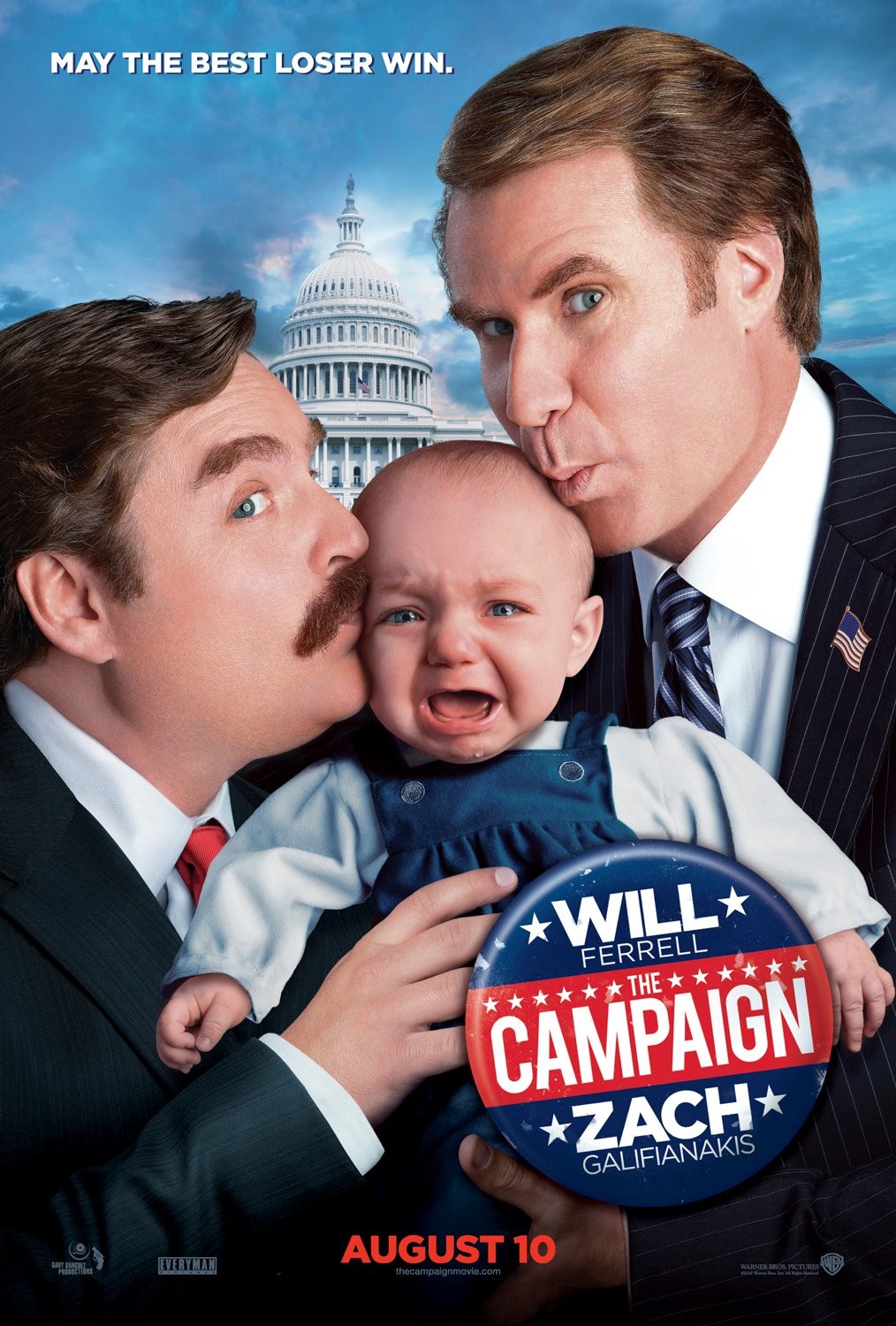
The Campaign
201285 minutes
rated R
by Scott Mendelson
Jay Roach's The Campaign is both painfully stupid and pointedly smart at the same time. As a film, it's a chaotic and implausible mess, going from one major event to another with no real connective tissue. It has outrageous events occur onscreen and mostly ignores the real-world implications of said event. Yes, it is technically 'funny' in that its major characters do and say things that elicit laughs. But those laughs come at a high cost, as the film often sacrifices its inherent drama and potential realism for the sake of extended improv riffs. But in terms of what the film has to say about modern politics, it is both insightful and painfully cynical. Jay Roach has played in the sandbox of real political drama, having helmed the superb Recount and Game Change for HBO. Like Ferrell's last big-scale vehicle, The Other Guys, it has whip-smart social and political commentary trapped inside a genuinely bad film.
Friday, August 10, 2012
Who cares and why bother? How national apathy and the 'death of outrage' killed the modern political thriller.

Wednesday, August 8, 2012
Preferential Patriotism: The strange "politics" of Kathryn Bigelow's Zero Dark Thirty.
There isn't too much to say about this brief teaser. The title is guaranteed to confuse a good 90% of general moviegoers and I'll be shocked if Sony doesn't add a "The Hunt For Bin Laden" subtitle in there before the film comes out in December. I may be the only one, but I laughed out loud at Jason Clarke repeatedly screaming "When was the last time you saw Bin Laden!?" It's the kind of "make sure the dumbest moviegoer sitting in the theater gets what this movie is about" moment that sticks out like a sore thumb. But what's worth noting more than the actual tease itself is the way the film will surely be judged by differing political factions. Obviously I haven't seen the film, but its pre-release vilification, best personified by Rep Peter King's hearings alleging that the film received classified materials during pre-production, is yet another example of how 9/11 changed the political conversation by basically making everything partisan.
Wednesday, July 18, 2012
Review: The Dark Knight Rises (2012) is the least of the Nolan Bat-films, continuing the curse of the comic book threequels.

The Dark Knight Rises
2012165 minutes
rated PG-13
by Scott Mendelson
First and foremost, I cannot decide at the moment if The Dark Knight Rises (trailer) is a 'better film' than Spider-Man 3, Batman Forever, and/or X-Men: The Last Stand. The fact that I have to outright state as much should tell you what a comparative disappointment this film is. Overall, its many storytelling flaws bring the picture down, offering only engaging acting, entertaining character interaction, and the kind of empty-headed (but oft impressive) action spectacle associated with more conventional blockbusters. It is a hodgepodge of several classic Batman stories squished into one chaotic narrative that ends up resembling a mash-up of Transformers: Dark of the Moon and Rocky III. There are moments of emotional engagement in the first third and the final moments pack an appropriate wallop. But the film frankly drags for much of its middle 90 minutes on its way to a surprisingly unremarkable climax. Save for mostly fine performances, including a terrific supporting turn by Anne Hathaway, and some wonderful character beats scattered throughout, this is sadly the very definition of an unnecessary sequel.
Thursday, June 28, 2012
Patent Zero: Why readily available health care for every person in America, via a nationalized single-payer system, is a national security issue.
Subscribe to:
Posts (Atom)
LinkWithin
